Internet Access is Spotty in the Driftless Region
At first glance, a broadband map looks technical—coverage zones, provider lines, reported speeds. But if you live in the Driftless, you read it differently. You see which ridges are lit and which hollows are not.
Purple areas show service.
Orange areas do not.
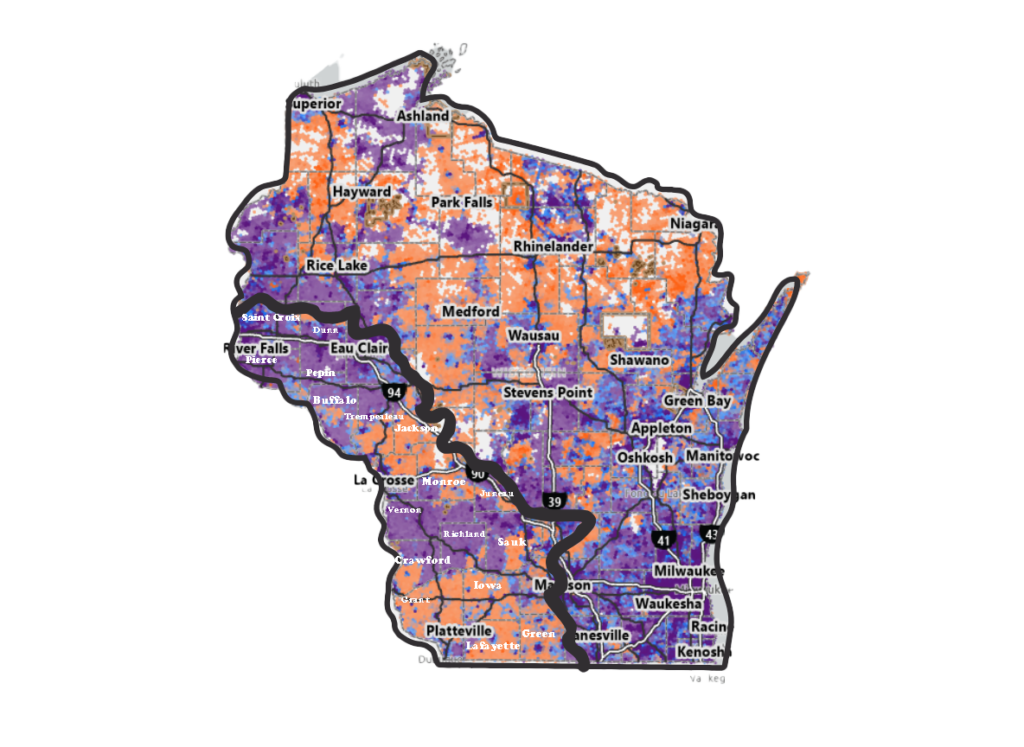
And the Driftless shows up in orange more than almost anywhere else in Wisconsin.
That isn’t accidental, and it isn’t temporary. It’s structural.
The southwest corner of the state — Iowa, Grant, Richland, Lafayette — sits in unglaciated terrain. Ridges, valleys, winding roads, scattered farms, houses tucked into hillsides. Beautiful land, but difficult infrastructure. Running fiber through this landscape costs more and reaches fewer people per mile than it does in flatter, denser parts of the state. So investment concentrates along highways and towns, and the ridges in between stay patchy.
You can see it on the map: purple bands tracing roads and town centers, then orange immediately outside them. Two houses a mile apart, same township, completely different internet reality.
That’s normal here.
I live in Iowa County, right in that patchwork zone. Our area shows partial coverage on paper, but like many rural homes, we rely on Starlink. Across the Driftless, it’s become the practical bridge between terrain and connectivity — especially for ridge properties, wooded parcels, and edge-of-town homes where fiber still hasn’t reached. Before satellite options improved, those locations meant slow DSL, unreliable fixed wireless, or nothing at all. Now they’re fully workable for remote jobs, streaming, and daily life. Sometimes, a satellite moves and your Outlook time zone changes, but other than that, the inconvenience is minimal.
In a quiet way, Starlink has expanded where modern Driftless living is actually possible.
This map ends up revealing something deeper than broadband status. It shows the underlying exchange that defines this region.
The Driftless trades connectivity density for landscape freedom.
You get space, quiet, views, dark skies, winding roads, and land that hasn’t been flattened or standardized. What you give up is uniform infrastructure. Services arrive unevenly. Availability changes parcel by parcel. Assumptions that work elsewhere in Wisconsin don’t hold here.
For anyone considering living in the Driftless, the lesson is simple and important: internet is an address-level reality. Not town-level. Not county-level. Here, you check the exact location.
The map doesn’t just show who has broadband. It also shows why technologies like Starlink have become so influential here and why the region still feels distinct in a state where connectivity is otherwise becoming uniform.